

 English
 العربية


Metallic Constituent Analysis
Metals and Trace Element Analysis
Identify metallic contaminants. Assess sample quality. Support informed environmental and operational decisions.
Environmental Testing and Laboratories Company (ETLCO) provides metals and trace element analysis for municipal, commercial, petrochemical, and industrial clients across Saudi Arabia.
Our Environmental Laboratory analyzes water, wastewater, sludge, and solid samples to support environmental monitoring, treatment performance assessment, contamination investigations, and verification against applicable project requirements.
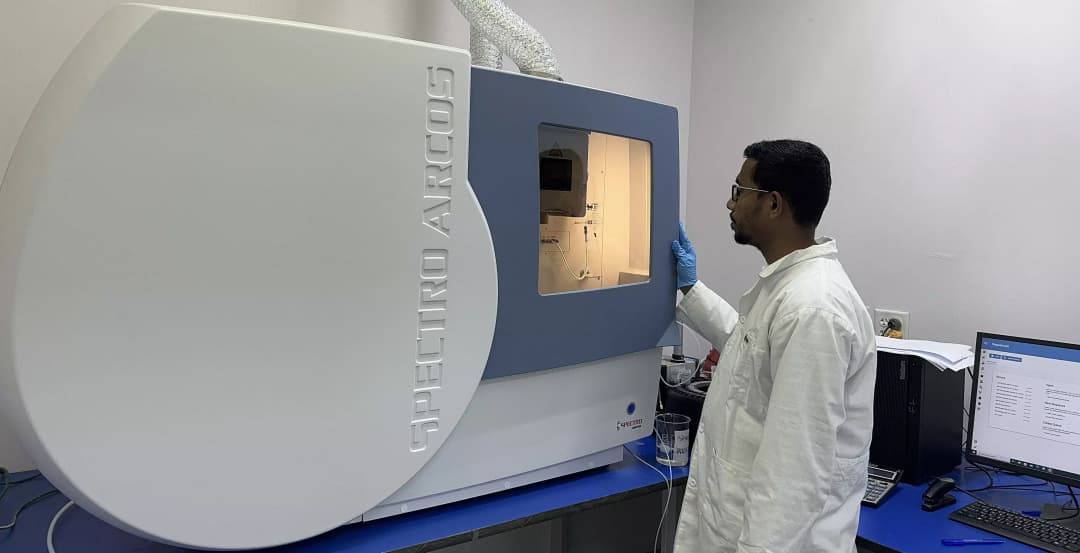
Using ICP-MS and ICP-OES instrumentation, our laboratory team develops testing scopes suited to the sample matrix, target elements, and required reporting limits.
Why Test for Metals?
Metals can occur naturally or enter water and other materials through industrial processes, corrosion, discharges, and waste handling. Their concentrations provide important information for evaluating quality, investigating contamination, and assessing treatment needs.
Metals analysis helps clients:
Determine concentrations of target metals and trace elements.
Compare results with applicable limits or agreed specifications.
Investigate potential contamination sources.
Evaluate treatment performance using samples collected before and after treatment.
Characterize sludge and solid materials for further assessment.
Establish baseline conditions and track changes over time.
Water and Wastewater Metals Analysis
Understand Water Quality and Treatment Performance
ETLCO provides metals testing for water and wastewater samples from municipal, commercial, and industrial sources.
Testing can support routine monitoring, process investigations, and the assessment of treated effluent. The analytical scope is selected according to the water source, intended use, expected concentrations, and project requirements.
Where relevant, the scope distinguishes between dissolved metals and total recoverable metals, as these require different sample handling and preparation.
Sludge and Solid Sample Analysis
Characterize Metallic Constituents in Complex Materials
Sludge and solid samples require preparation suited to their composition and the purpose of the investigation.
ETLCO provides metals analysis to support material characterization, contamination assessments, and waste management evaluations. Appropriate preparation and digestion procedures are selected before instrumental analysis.
The preparation method influences the fraction of metals measured, so results are reported in relation to the agreed analytical scope.
Our Metals Analysis Technologies
ICP-MS — Inductively Coupled Plasma Mass Spectrometry
ICP-MS supports the measurement of multiple elements at low concentrations. It is particularly useful when projects require trace-level analysis and reporting limits appropriate to low assessment thresholds.
Method references include:
US EPA Method 200.8.
APHA Standard Methods 3125.
US EPA SW-846 Method 6020.
The applicable method and revision are selected according to the sample matrix, target elements, and laboratory procedure.
ICP-OES — Inductively Coupled Plasma Optical Emission Spectrometry
ICP-OES provides multi-element analysis for a range of environmental and industrial samples. It supports routine metals testing and investigations across suitable concentration ranges.
Method references include:
US EPA Method 200.7.
APHA Standard Methods 3120.
US EPA SW-846 Method 6010.
ICP-OES is also referred to as ICP-AES, or inductively coupled plasma atomic emission spectrometry, in some method titles.
Mercury Analysis
ETLCO offers mercury analysis as part of a defined metals testing scope. Sample preparation, preservation, analytical technique, and reporting limits are selected according to the sample type and project requirements.
Our laboratory team can confirm the appropriate mercury testing approach before sample submission.
Recognized Methods and Project-Specific Testing
ETLCO uses recognized methodologies from US EPA, APHA Standard Methods, and ASTM, where applicable to the requested analysis.
Before testing begins, we review:
The sample matrix and source.
The required metals or trace elements.
Whether dissolved, total recoverable, or another defined fraction is required.
The relevant specification or assessment criteria.
The reporting limits needed for the project.
Sample preparation, preservation, and handling requirements.
This review helps align the laboratory work with the decisions the results need to support.
Applications Across Municipal and Industrial Sectors
Environmental Monitoring
Measure metallic constituents as part of baseline studies, periodic monitoring, and contamination investigations.
Wastewater Treatment Assessment
Compare concentrations before and after treatment to help assess metal removal and identify areas requiring further investigation.
Industrial and Petrochemical Operations
Investigate metals in process-related water, wastewater, sludge, and solid materials to support operational and environmental assessments.
Sludge and Waste Characterization
Obtain analytical data to support evaluation of sludge and solid waste. Where a project requires leachability testing, this is defined separately from bulk metals analysis.
Reporting That Fits Your Project
ETLCO recognizes the importance of timely analysis and clear reporting. Turnaround requirements and reporting formats are discussed before the project begins so that deliverables align with client needs.
Depending on the agreed scope, reporting can include:
Sample identification and descriptions.
Results for each requested element.
Units and applicable reporting limits.
Analytical method references.
Relevant result qualifiers.
Presentation aligned with project templates or monitoring schedules.
Where comparison with specified criteria is requested, the reference limits and reporting approach are agreed in advance.